Text
For centuries, food has transcended mere sustenance to become a profound semiotics of power. It serves as a silent language of status, a claim to moral high ground, and the primary architect of social belonging. This alchemy—transforming the edible into the ideological—is the cornerstone of cultic devotion and, increasingly, the North Star of luxury brand strategy.
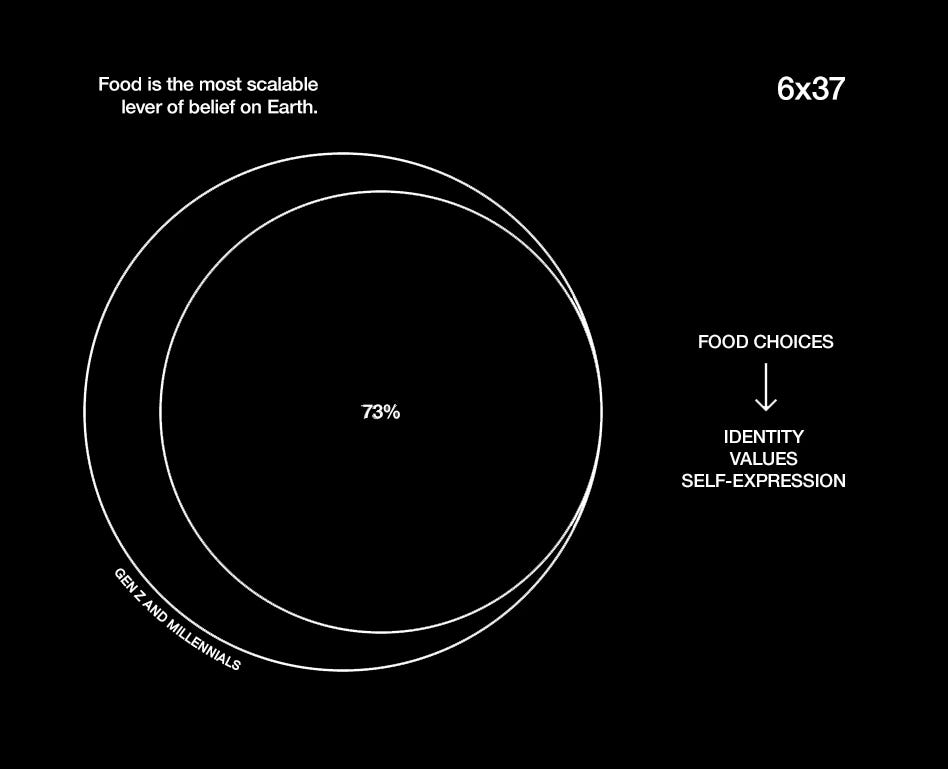
According to a 2023 Deloitte study, 73% of Gen Z and Millennials say their food choices are tied to identity and self-expression, more than fashion, fitness, or even political affiliation. The dinner plate has become the new canvas for the soul; what we consume now carries more weight than what we wear.
Appetite as control.
There exists a dark liturgy in the way we eat. Since the era of Aquinas, the human experience has framed the swallow and the fast as markers of spiritual health—finding the profane in the feast and the sacred in the void. Appetite is the ultimate lever of control. By delineating the boundaries of the “clean” and the “forbidden,” power migrates from the stomach to the psyche.
Dr. Alexandra Stein identifies a terrifying bypass in human autonomy: when survival itself is weaponized, independent thought becomes the first casualty. This is the precision of the cultic craft—transforming the body into an obedient vessel so that the mind has no choice but to follow.
- Jonestown: Food served both symbolic and disciplinary purposes, a grim prelude to the liquid “Kool-Aid” that would eventually immortalize the group’s final surrender.
- Fruitlands: In this Transcendentalist commune, members eschewed even root vegetables in pursuit of moral purity. Their agricultural failure underscored a universal truth: in the realm of the zealot, belief often precedes practicality.
- NXIVM: In this twenty-first-century personality cult, food deprivation functioned as a ritual of erasure. It was not about health, but about proving the discipline required to “belong.”
Symbolic ingestion.
Indoctrination is never more effective than when it is delicious. In the 1970s, The Source Family transformed organic juices into “spiritual praxis.” Today, luxury houses have perfected this alchemy. The Prada Café, Gucci Osteria, and Louis Vuitton’s signature chocolates are not mere lifestyle extensions; they are sophisticated instruments of brand entry.
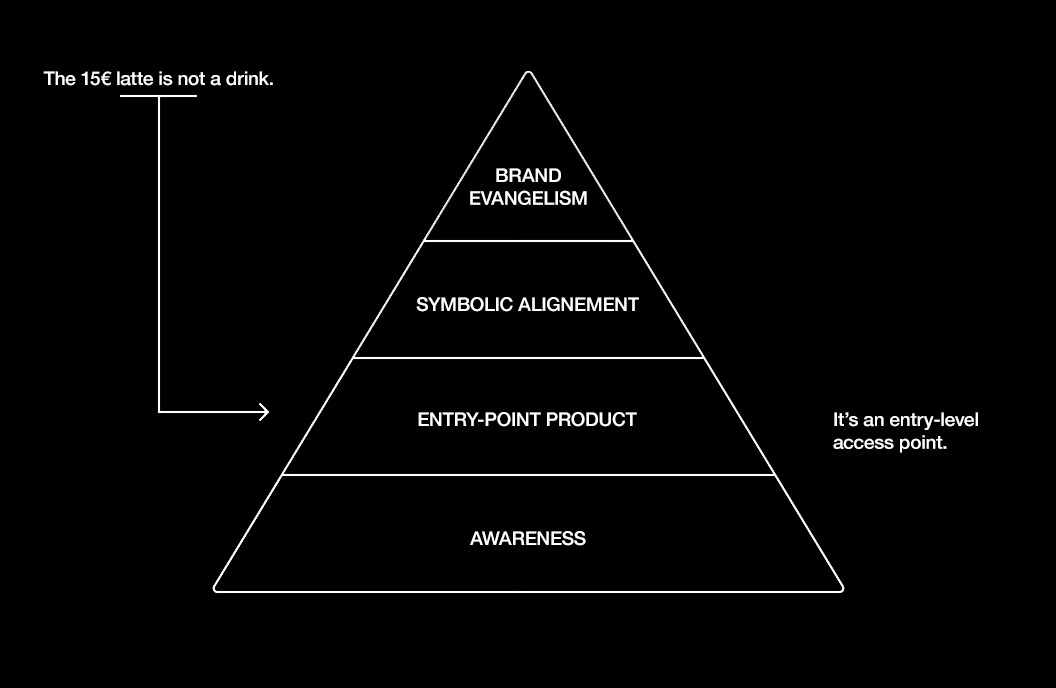
For those unable to access an $11,000 handbag, a $15 latte becomes an aspirational gateway. This is symbolic ingestion masquerading as democratization.
We have entered the realm of Jean Baudrillard’s Simulacrum. The café becomes a mise-en-scène; the croissant becomes a symbol detached from sustenance. Appetite is no longer the driver; cultural alignment is. We do not eat to resolve hunger; we eat to communicate taste. In this new hierarchy of senses, the “phones eat first.”
According to McKinsey, entry-point SKUs that facilitate symbolic alignment drive significantly higher brand loyalty than traditional awareness campaigns. Because the fortress of top-tier luxury is inaccessible to many, these gastronomic formats offer a “temporary belonging” that preserves brand equity while widening the net of influence.
This dynamic echoes the moral landscape of Ancient Greece, where appetite was the litmus test for civic virtue. Modern wellness culture is the direct heir to this philosophy; “clean eating” has emerged as a moral framework masquerading as health. The subtext remains unchanged: dietary mastery equates to ethical superiority.
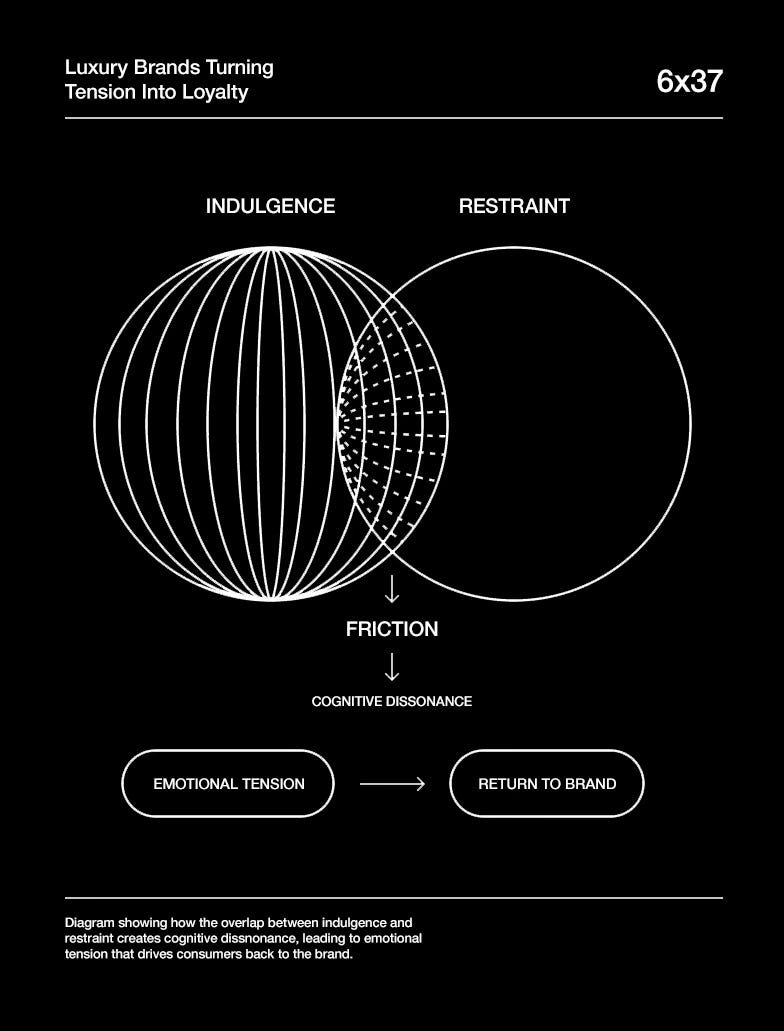
The brand becomes both the architect of the tension and the exclusive path to relief.
Luxury brands expertly exploit this contradiction. They promote the fantasy of indulgence while simultaneously glorifying the aesthetic of deprivation. Social media serves to reinforce this duality, creating a “control matrix” where the consumer must embody both restraint and excess.
Performance, purpose and spectacle.
Occasionally, a brand successfully aligns substance with symbol. Stella McCartney’s Osaka-based café, “Stella’s World,” acts as a visceral extension of the brand’s animal-rights ethos, translating ethical conviction into a culinary offering. Here, the meal is an edible manifesto.
More often, however, brands settle for performance over purpose. When Louis Vuitton produces gyoza-shaped clutches or lobster-themed bags, food is reduced to a high-fashion gimmick—an object not designed for consumption but staged for digital replication.
This is the ultimate triumph of the Simulacrum. The consumer acts as both patron and distributor, seeking cultural alignment rather than biological satisfaction. We no longer eat to resolve hunger; we eat to communicate taste. The chasm between function and form has widened to the point that even a cappuccino serves primarily as proof of ideological fit.
The scalable ritual.
This simulation, however, carries a risk: it erodes substance. When food becomes mere “content,” it loses its long-term symbolic charge, and luxury risks degrading into a shallow commodity. Yet, from a strategic perspective, this shift is rational.
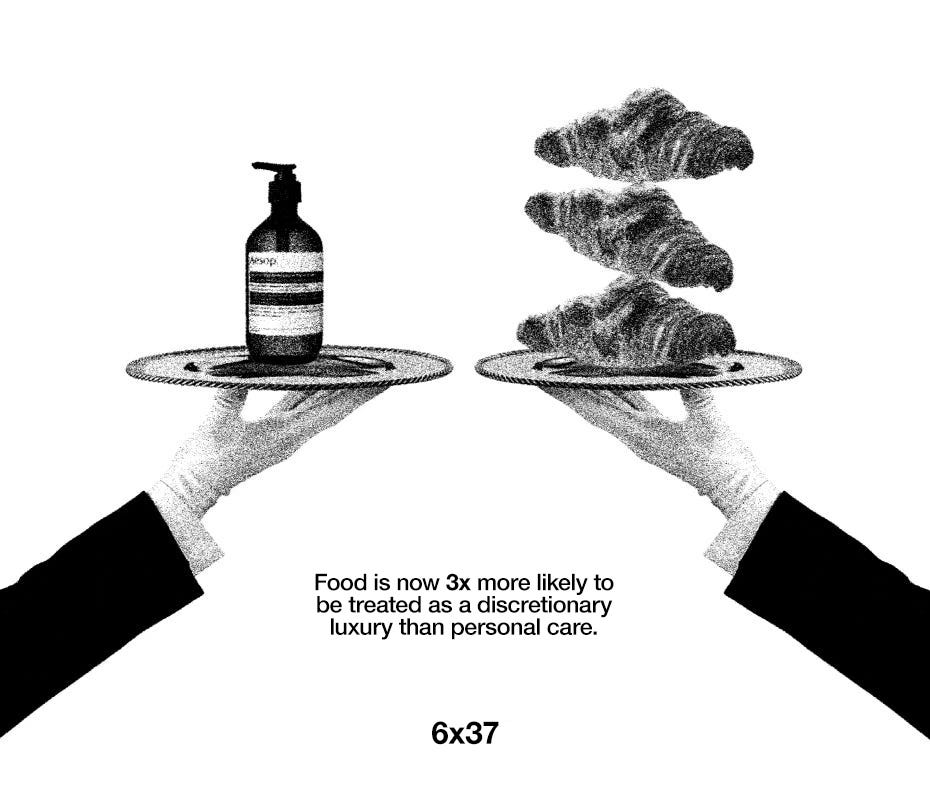
In an era of shrinking middle-class access, food has emerged as the most accessible gateway to aspiration. Deloitte confirms that food and beverage purchases are now three times more likely to be treated as “indulgent luxuries” than personal care products.
Deloitte’s Global Consumer Tracker confirms what the luxury sector has long intuited: food provides a high-impact, low-commitment path to brand participation. For marketers, it represents the most scalable form of emotional buy-in.
Three patterns of control.
The Elevation of the Artifact. In cultic settings, food is never merely sustenance; it is presented ceremonially. Luxury brands mirror this discipline through rigorous aesthetic control. Brand teams must elevate every product touchpoint to the level of a semiotic artifact.
The Consecrated Vocabulary. Cults recode the mundane into the divine through restriction, renaming, and ritual. Luxury menus achieve this same “verbal distance” through linguistic exclusivity. Terms such as biodynamic, single-origin, stone-milled, and wild-harvested become markers of status differentiation.
The Architecture of Belief. Cults historically initiate members through consumption-based trials: fasts, cleanses, and dietary commandments. Luxury replicates this through hospitality choreography and digital spectacle. The tasting menu, the curated café ritual, and rigid aesthetic protocols are modern forms of initiation.
Cults used food to construct control, extract labor, and define identity. Luxury now does the same. The difference is one of polish, not intention.
What we eat has become a primary site of identity formation and ideological alignment. For brands, this is no longer a symbolic gesture; it is a strategic lever. By mastering the stomach, the brand masters the self.
The transition from consumer to devotee is complete when consumption is no longer about nourishment, but about salvation through style.